The formula
Residential rental buildings depreciate over 27.5 years, straight-line:
Annual Depreciation = Building Basis ÷ 27.5
Two definitions matter:
- Building basis is the purchase price, plus certain closing costs and improvements, minus the value of the land. Land never depreciates.
- 27.5 years applies to residential rentals. Commercial property uses 39 years.
Worked example
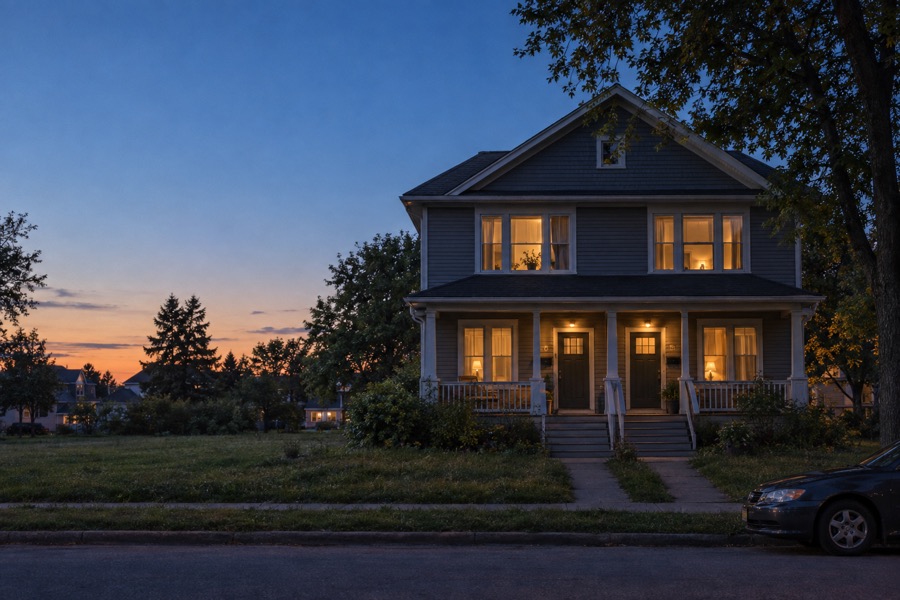
Say you buy a duplex for $425,000, and the county assessor attributes 20% of the value to land:
| Line | Amount |
|---|---|
| Purchase price | $425,000 |
| Less land (20%) | −$85,000 |
| Depreciable building basis | $340,000 |
| ÷ 27.5 years | |
| Annual depreciation deduction | $12,364 |
That's $12,364 a year you deduct against rental income without spending a dollar, on top of actual expenses like taxes, insurance, and repairs.
If the property nets $8,000 a year in cash flow, depreciation can turn a taxable profit into a paper loss. That's why experienced landlords often show losses on their tax returns while collecting real cash.
The mid-month rule
Real estate uses a mid-month convention. Whatever month you place the property in service, the IRS treats it as the middle of that month. Buy in July and your first year gets roughly 5.5 months of depreciation (about $5,667 in the example above), not a full year.
How to split land from building
The IRS requires a "reasonable" allocation. The three common methods, from easiest to strongest:
- Assessor's ratio. Use the land-to-total ratio from your property tax assessment. Easiest to defend, most common.
- Appraisal allocation. If your purchase appraisal broke out land value, use that.
- Cost segregation study. A paid engineering study (more below) that also opens the door to faster depreciation.
Land ratios vary hugely: 10-20% in much of the Midwest and South, 40% or more in expensive coastal metros. Don't guess low. An aggressive land allocation is a common audit adjustment.
Bonus depreciation in 2026: what actually changed
You'll see headlines about "100% bonus depreciation is back." What it actually means for landlords:
- The One Big Beautiful Bill Act (July 2025) permanently restored 100% bonus depreciation for qualified property acquired after January 19, 2025.
- Bonus depreciation applies to property with a class life of 20 years or less: appliances, carpeting, certain fixtures, and land improvements like fences and driveways. It does not apply to the building itself, which stays on the 27.5-year schedule.
- To use it at scale, investors order a cost segregation study, which reclassifies 20-30% or more of a building's basis into 5-, 7-, and 15-year components that qualify for the immediate write-off.
Example: on that $340,000 building basis, a cost seg study that reclassifies 25% ($85,000) into bonus-eligible components would let you deduct that $85,000 in year one, on top of regular depreciation on the rest. Studies typically cost $3,000 to $10,000, so they make the most sense on larger properties or high-income years. (More on the 2026 rules.)
One caveat: big year-one losses only help if you can use them. For most people, rental losses are passive and limited to $25,000 against ordinary income (phasing out above $100,000 MAGI), unless you qualify as a real estate professional. Unused losses carry forward.
Depreciation recapture: the bill that comes due
This is the part that surprises people at the closing table.
When you sell, the IRS recaptures the depreciation you took. It also recaptures depreciation you could have taken but didn't, so never skip claiming it. Unrecaptured Section 1250 gain is taxed at up to 25%, separate from the capital gains rate on the rest of your profit.
Using our duplex: hold it 10 years, take about $123,600 of depreciation, and sell. You'd owe up to roughly $30,900 in recapture tax on top of capital gains.
Ways investors handle recapture:
- 1031 exchange. Defer both capital gains and recapture by rolling into a like-kind property. See our 1031 exchange guide.
- Hold until death. Heirs get a stepped-up basis, and the recapture liability disappears under current law.
- Just pay it. Deferring tax for 10+ years at 0% interest is still a good deal. Recapture doesn't erase the benefit, it discounts it.
How depreciation changes your deal math
Depreciation doesn't show up in cap rate or cash-on-cash, since those are pre-tax metrics. Where it matters:
- After-tax cash flow. A property with $8,000 cash flow sheltered by $12,364 of depreciation beats a stock dividend of $8,000 taxed at your marginal rate.
- Total ROI. Tax savings are one of the four return streams: cash flow, appreciation, principal paydown, and tax benefits. Our ROI calculator breaks these out.
- Comparing deals. Two properties with the same cap rate but different building/land splits have different after-tax returns. High-land-value markets give you less to depreciate.
FAQ
Do I have to take depreciation?
Effectively yes. The recapture rules apply to depreciation "allowed or allowable," meaning you'll be taxed at sale as if you claimed it, whether or not you did. Skipping it means paying the bill without ever getting the benefit. If you've skipped it in past years, a CPA can fix it with a Form 3115 catch-up.
Can I depreciate my primary residence?
No. Only property used to produce income. If you house-hack a duplex, living in one unit and renting the other, you depreciate the rental unit's share. Our house hacking guide covers the details.
What about improvements vs repairs?
Repairs (fixing a leak) are deducted in full the year you pay them. Improvements (new roof, addition) are added to basis and depreciated. The distinction gets genuinely fuzzy at the margins. This is CPA territory.
Does depreciation reduce my basis even in loss years I couldn't use?
Yes. Basis goes down by the depreciation allowable each year regardless of whether the passive loss rules let you use the deduction currently. The suspended losses carry forward and typically free up when you sell.
Is the 27.5-year schedule ever different?
Foreign residential rental property uses 30 years (ADS), and certain elections force ADS schedules. For a normal US residential rental, 27.5 is the number.
Key takeaways
- The formula: (price − land) ÷ 27.5 for residential rentals. Land never depreciates.
- On a typical $425k duplex, that's roughly $12,000 a year in deductions without spending anything.
- 100% bonus depreciation is back permanently for property acquired after January 19, 2025. It applies to short-life components, not the building. Cost segregation is how you reach it.
- Recapture is real. Up to 25% of every dollar you deducted comes due at sale, unless you 1031 or hold.
- Always claim it. You're taxed as if you did anyway.
Related reading
- Rental Property Tax Deductions: the full deduction checklist
- 1031 Exchange Guide: deferring gains and recapture
- Cash-on-Cash Return Guide: the pre-tax return metric depreciation doesn't touch
Keep reading
- 1031 Exchange Rules: Timelines, Like-Kind Property and What Gets DeferredHow a 1031 exchange defers capital gains on a property sale: the like-kind and equal-value rules, the 45 and 180 day deadlines, and where exchanges fail.
- Break-Even Occupancy: How Empty a Rental Can Get Before It Loses MoneyThe break-even occupancy and break-even rent formulas for a rental property, worked with real numbers, and what the result says about risk and financing.
- The BRRRR Method: Buy, Rehab, Rent, Refinance, Repeat, With the MathHow the BRRRR method works step by step, how much cash the refinance actually returns, and where the numbers break when the appraisal comes in low.